.png)

Who Gained Ground in WMS and Who Quietly Slipped
Everyone watches the Magic Quadrant. Far fewer people read the report sitting right next to it.
Gartner's Critical Capabilities for Warehouse Management Systems doesn't rank vendors on market presence or vision - it scores the actual products on what they can do. And because Gartner has now published four editions of it, you can do something the single-year snapshot won't let you: watch the field move.
We track this closely because we spend our days inside these platforms on the implementation side. So we pulled the Critical Capabilities reports from 2022 through to 2026, and mapped how each major platform's standing shifted in complex warehouse operations, where most serious distribution and fulfillment work actually happens.
Here's what moved.
First, two honest caveats
Good analysis starts by admitting what the data can and can't say.
There are three reports, not five. The 2023 report is also nearly identical to 2022, so for better representation, we've presented the inflection points as 2022 → 2024 → 2026.
Raw scores aren't comparable across all years. In 2026, Gartner added two new scored capabilities — systems/technical architecture and intralogistics smart robotics — and re-weighted everything. The mechanical result was that almost every product's absolute score moved, regardless of whether the product itself changed. Comparing raw 2022 scores to raw 2026 scores would tell you a false story.
So throughout this piece we compare relative standing, where each platform ranked against its peers, rather than raw point totals. Rank survives a methodology change; absolute scores don't.
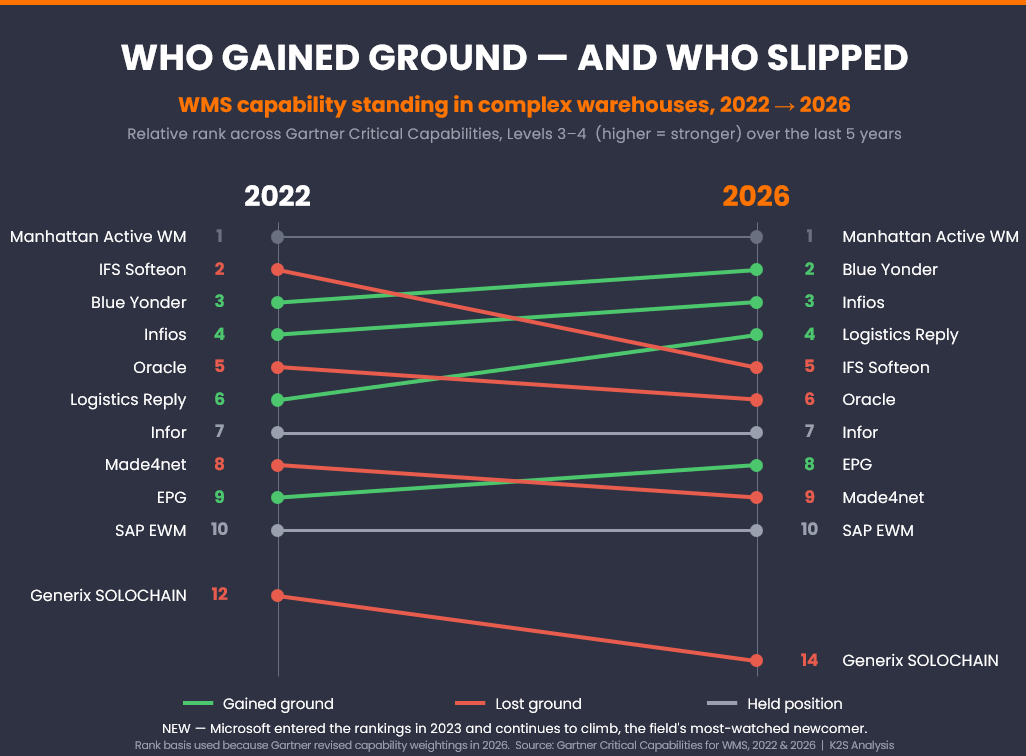
Who gained ground
Blue Yonder is the steadiest hand at the top. Across three name changes, a Panasonic acquisition, and a full rebuild of its core platform onto a cloud-native architecture, it held — and strengthened — its position as the strongest non-Manhattan platform for complex operations. In a market this turbulent, holding the top of the table is itself the achievement. Stability at that altitude is rarer than it looks.
The cloud-native architecture players climbed. The clearest riser built its current platform from scratch on a modern microservices foundation — exactly the quality Gartner started scoring harder in 2026 — and moved up several positions on the strength of it. Architecture stopped being a back-office detail and became a front-line differentiator.
The acquisition-fueled consolidator climbed too — and made the single largest jump of anyone in highly automated environments, where its standing rose sharply on the back of years of bolt-on acquisitions in warehouse execution and automation software.
And a genuine newcomer arrived. A platform that wasn't in these rankings at all a few years ago entered in 2023 and has been climbing since — now the most-watched newcomer in the category, carried by an enormous installed base and cloud ecosystem.
Who held the line
Not every story is movement. Several established platforms held their relative position across the full span, neither gaining nor losing ground as the field reshuffled around them. In a market where the average product's capability set expanded significantly, simply keeping pace required real, sustained investment. Standing still on the leaderboard meant running hard underneath.
Who slipped
This is where the methodology discipline matters most, because "slipped" here means lost ground relative to peers, not "got worse."
The biggest erosion came from a long-established megavendor platform whose complex-operations standing fell more than any other major name. It didn't break — but as cloud-native and robotics-orchestration capabilities became scored battlegrounds, a platform anchored in older architecture lost relative ground to rivals investing faster in exactly those areas.
Several strong specialists also slipped in the complex tier — but the headline is misleading without context. Some of the platforms that dropped at the high-complexity levels are, in fact, leaders at lower-complexity operations. One of them ranks at or near the very top for simpler, midmarket warehouses. They didn't decline; they're simply built to win on a different battlefield, and the high-complexity ranking isn't the field they're playing on.
One elite specialist did slip within the top tier — from roughly second to fifth in complex-operations standing. The nuance: that original second-place finish was a near-tie decided by hundredths of a point, the platform never left the elite top five at any complexity level, and the drop reflects others rising past it rather than any loss of capability. It remains a strong product, now backed by significantly greater scale following its acquisition.
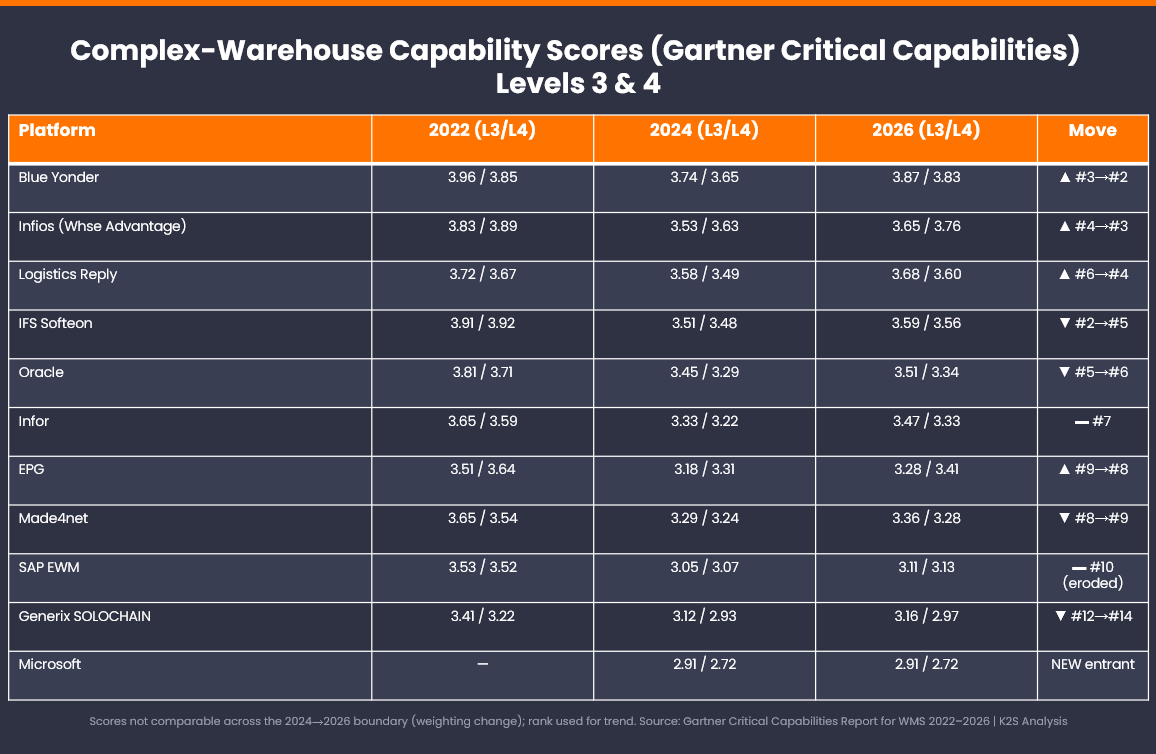
Why the ground moved
Step back from the individual names and a single force explains most of the movement: Gartner started scoring what the modern warehouse actually needs.
The two capabilities added in 2026 — technical architecture and robotics orchestration — weren't cosmetic. They rewarded platforms that had rebuilt on cloud-native, composable foundations and that could orchestrate mixed fleets of automation and robotics in real time. Platforms that had made those investments rose. Platforms leaning on legacy architecture, or treating automation as a bolt-on, slipped.
Three structural shifts sit underneath that:
- Architecture became a front-line capability. Cloud-native, microservices, composability, once IT-department concerns, now move a product's score directly.
- AI moved from differentiator to baseline. Every leading platform now embeds machine learning and generative-AI capabilities. Having AI no longer sets you apart; not having it now counts against you.
- Acquisition accelerated capability. The fastest climbers largely bought their way to breadth, folding in warehouse execution, voice, transportation and order-management capabilities, while organic-only platforms struggled to keep pace.
What it signals for the next three years
The 2026 report's forward-looking assumptions point clearly at where the next round of movement will come from:
- By 2029, technical architecture will matter as much as functionality to new buyers. The thing that reshuffled the 2026 rankings is about to weigh even heavier.
- By 2029, 75% of buyers will rank user experience among their top three criteria — up from 45% today. UX is becoming a deciding factor, not a tiebreaker.
- By 2029, 30% of warehouse robots will run on vendor-agnostic orchestration platforms managing mixed fleets. The single-vendor robotics era is ending.
- By 2031, 75% of WMS vendors will embed AI agents to handle exception management and cut execution latency.
Read together, the platforms that win the next four years won't necessarily be the ones with the longest feature list. They'll be the ones with the architecture, usability and orchestration to keep absorbing change without a rebuild.
The takeaway
A single year's ranking tells you who's strong today. Four years of the same data tells you something more useful: who's building in the right direction, and who's running to stand still.
That trajectory is what we pay attention to. We don't advise on which WMS to buy. That's not our lane. But living inside these platforms on the implementation side, watching where the real engineering investment is flowing tells us where the market is heading long before it shows up in a headline. The capability data, read across time, is one of the clearest signals there is.
Source: Gartner, Critical Capabilities for Warehouse Management Systems (2022-2026). Relative-standing analysis by K2S. Rank-based comparison used because Gartner revised its capability weightings in 2026.

.png)