.png)

The cover changes every year. The bottleneck doesn't.
What seven years of the MHI Annual Industry Report taught me about why supply chain technology stalls, and what actually moves it.
I read the MHI Annual Industry Report every year. It is one of the few industry surveys that talks to enough supply chain professionals to be worth the time, and I have watched it track our world through a strange stretch of history: a pandemic, a labor crisis, a spending boom, and now the arrival of AI on the warehouse floor.
This year I did something different. I lined up seven of them, 2020 through 2026, and read them back to back. What I found was not what I expected.
The covers changed. Every single year.
Each report picks a theme, and the themes tell you exactly what the industry was worried about at the time.
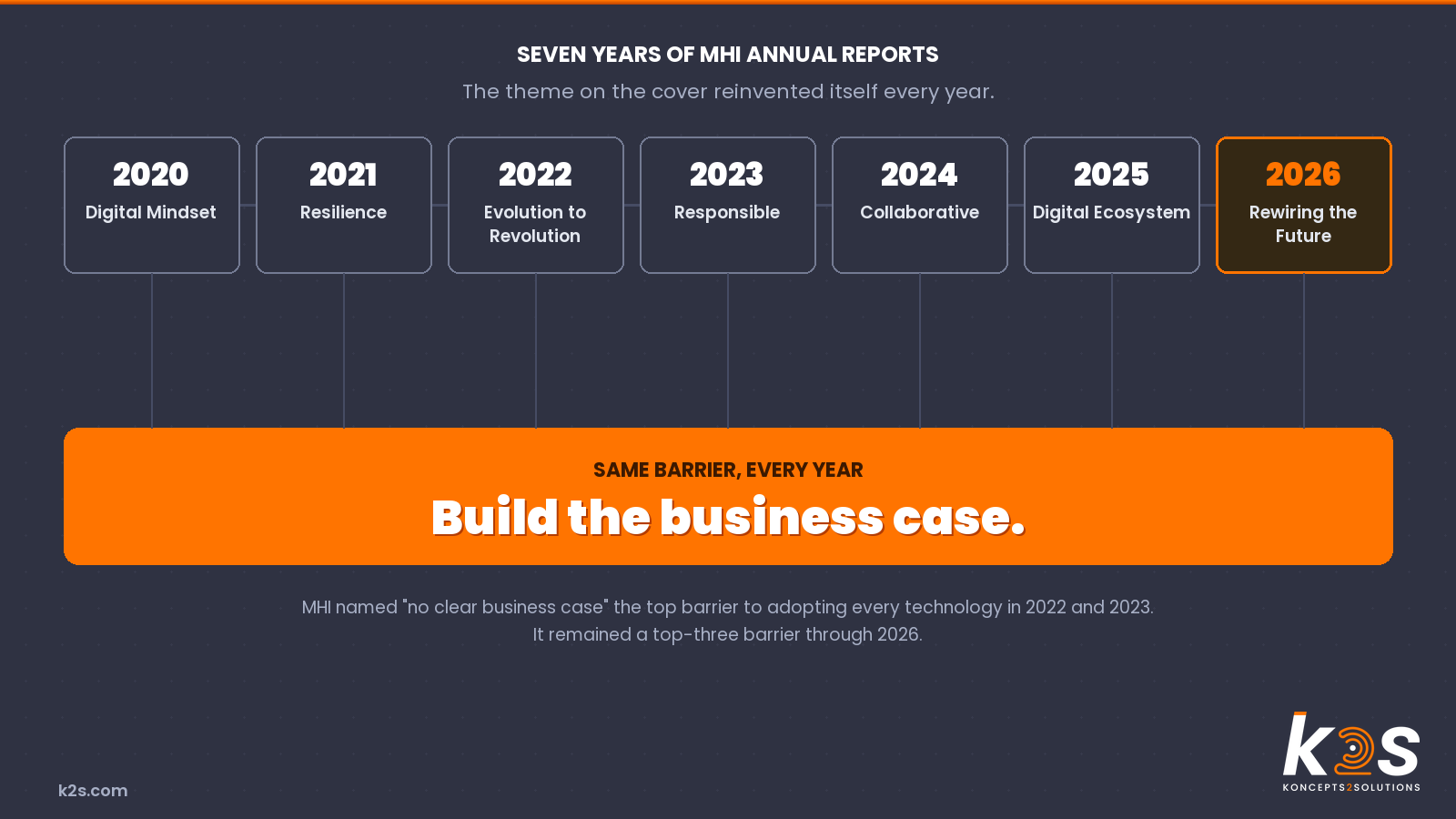
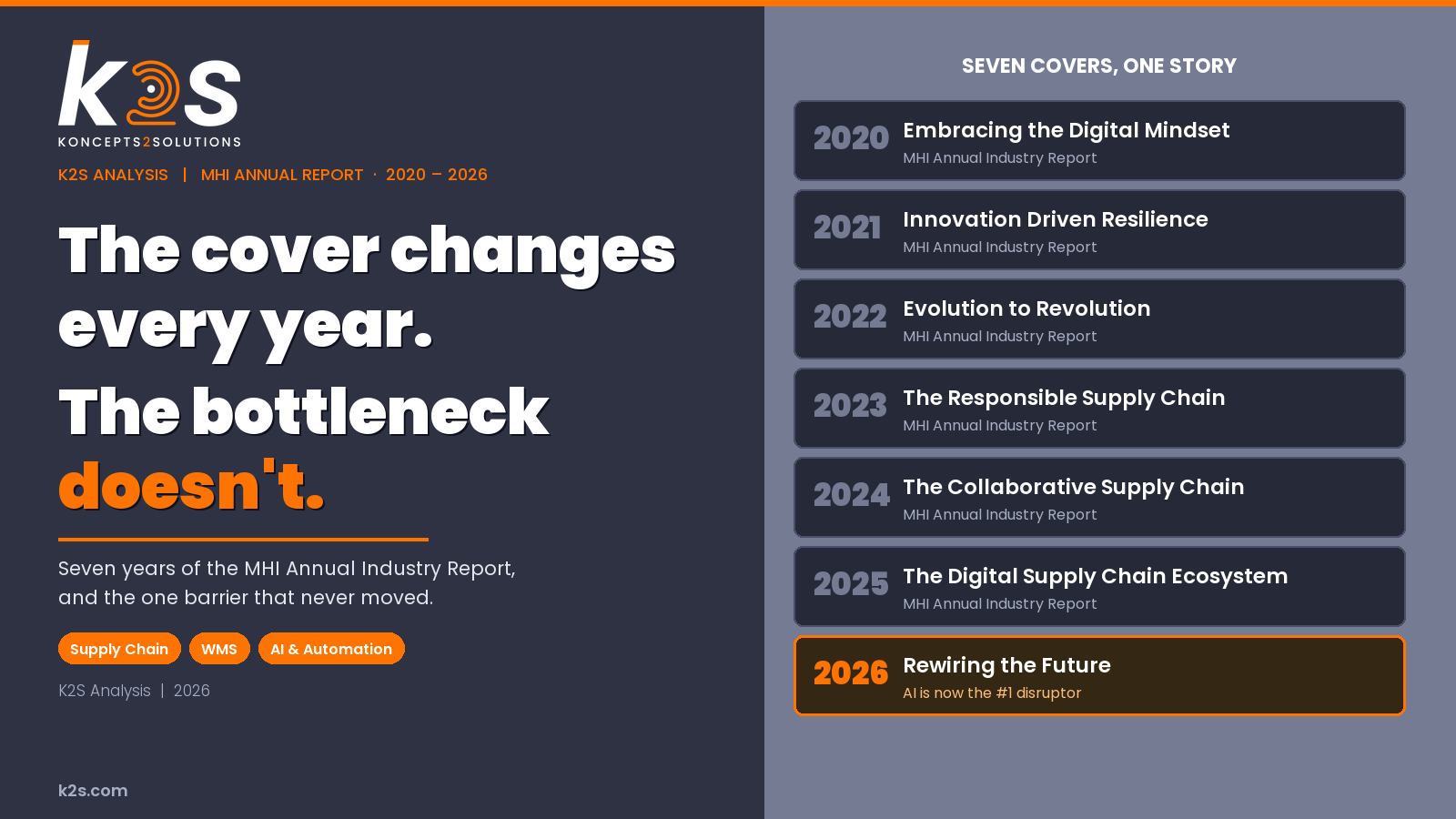
In 2020 it was Embracing the Digital Mindset. Then COVID hit, and 2021 became Innovation Driven Resilience. 2022 pushed harder with Evolution to Revolution. 2023 turned to sustainability with The Responsible Supply Chain. 2024 was The Collaborative Supply Chain, the year generative AI showed up in the survey for the first time. 2025 gave us The Digital Supply Chain Ecosystem and the word everyone started using, orchestration. And 2026 is Rewiring the Future, the year AI is finally ranked the number one disruptive technology of the decade, with its disruptive impact up 25 points in a single year.
Seven covers. Seven themes. A clean line from resilience to responsibility to collaboration to orchestration to rewiring. If you only read the titles, you would think the industry reinvents itself every twelve months.
The barrier underneath never moved.
Here is the part that stopped me.
For all the change on the covers, the thing standing between companies and their technology has barely shifted. In 2022, MHI named the single biggest barrier to adopting every technology it tracked: no clear business case. In 2023, same answer, word for word. And in 2026, after the AI boom, after orchestration, after all of it, a lack of clear business case is still sitting at the top of the barrier list, just behind cybersecurity.
The tools got smarter. The slides got flashier. The wall stayed exactly where it was.
I have seen this from the inside for twenty years. Before it was Blue Yonder, it was JDA. Before that, RedPrairie. The platform reinvented itself twice, and every time, the teams that struggled were not the ones with the wrong software. They were the ones who could not answer a simple question in plain numbers: what does this fix, and what is it worth.
The money told the same story.
You can see the same pattern in what companies actually spent.
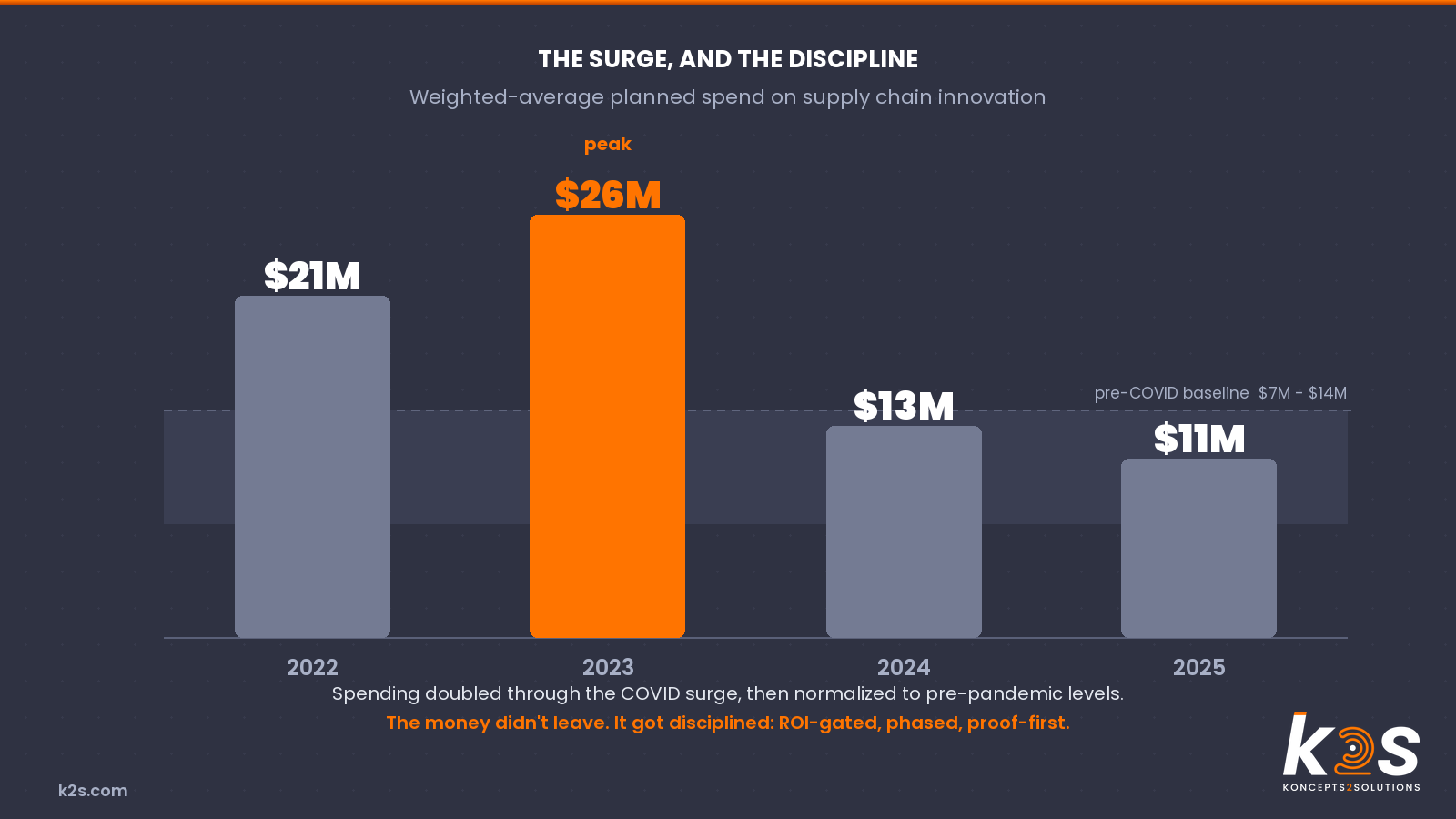
Planned spend on supply chain innovation doubled through the COVID surge, from a pre-pandemic baseline of roughly $7M to $14M up to a $26M peak in 2023. Then it came right back down, $13M in 2024, $11M in 2025.
It would be easy to read that as a pullback. It is not. The money did not leave. It got disciplined. The 2026 survey is full of it: leaders now treat innovation like a risk-managed portfolio, with pilots, proof-of-value gates, and measurable payback before anything scales. Capital is available. It is just gated by exactly the thing that has been the barrier all along, a credible business case.
Why the business case is really an execution problem.
Here is what I think most people miss. A missing business case is rarely a spreadsheet problem. It is an execution problem wearing a spreadsheet's clothes.
The 2026 report puts hard numbers on it, borrowing from Deloitte: only 14 percent of organizations have AI solutions ready to deploy, and just 11 percent are running them in production. Most pilots never make it off the pilot. The report's own line is the one I keep coming back to: you cannot out-execute a bad design.
You cannot build a business case for a system you do not fully understand, running on data you do not fully trust, executed by a floor that does the work a little differently at every site. That is why the same “no business case” barrier survives every rebrand of every platform. The tech is not the hard part anymore. Connecting it to how the work actually gets done is.
The report calls the answer orchestration, a sense, decide, execute, learn loop with people kept in the loop on the decisions that matter. I would put it more plainly. The winners are the ones who start with an honest look at their own operation before they buy anything.
What actually moves it.
If seven years of this report point anywhere, it is here.
Start with an operational assessment, not a purchase. Get a clear, current picture of your process flow, your labor, your data quality, and your integration points. Pick the one constraint that is actually costing you, and build the case around fixing that, with a real before-and-after in dollars, throughput, safety, and service.
Then prove it small before you scale it wide. A phased rollout with a genuine proof-of-value turns an investment decision from a leap of faith into a controlled step. It is also, not by accident, how you finally clear that business-case barrier that has been standing there since 2020.
This is the work we do at K2S. We have been through every rebrand of the platform, and the lesson has held the whole way: the technology on the cover will keep changing. What separates the companies that get value from it is whether they can connect it to the way their operation really runs.
The cover will change again next year. Make sure the thing underneath is finally moving.
K2S is a supply chain IT consulting firm specializing in WMS implementations.
If your team is staring at a business case you cannot quite close, that is exactly the conversation we like to have. Talk to our team.
Source: MHI Annual Industry Reports, 2020 to 2026 (MHI and Deloitte).

.png)